
ERP Managed Services: Maximizing Value After ERP Implementation
ERP Go-Live Is Not the Finish Line
An ERP implementation can represent a significant investment in technology, people, processes, and organizational change.
But once the system goes live, a new challenge begins:
How do you ensure the ERP continues to deliver business value as the organization, processes, users, and technology evolve?
Business requirements change. New users join. Processes are modified. Integrations evolve. Transaction volumes increase. New regulatory requirements emerge. Technology platforms receive updates.
Without continuous support and optimization, even a well-implemented ERP environment can gradually become less efficient, less reliable, and less aligned with business priorities.
This is why ERP success should be viewed as an ongoing journey rather than a one-time implementation project.
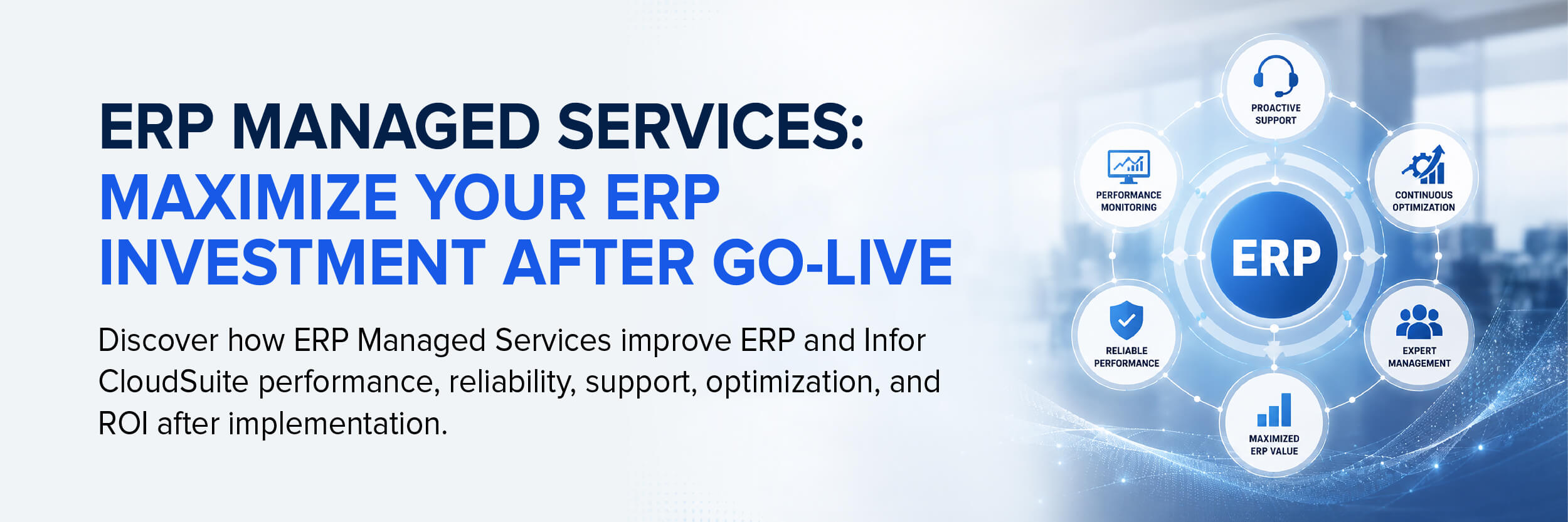
ERP Managed Services provide organizations with the expertise, monitoring, support, and optimization required to maintain system performance while continuously improving the value of their ERP investment.
Why Post-Go-Live Support Matters
The period immediately following an ERP implementation is critical.
Users are adapting to new processes. Support teams are addressing unexpected issues. Business teams are identifying enhancement requirements. IT teams are monitoring system performance and integrations.
Without structured post-go-live support, organizations may experience:
- Growing support backlogs
- Recurring incidents
- Slow issue resolution
- Performance degradation
- User adoption challenges
- Integration failures
- Unplanned downtime
- Increasing maintenance effort
Over time, these issues can affect productivity and create friction across finance, manufacturing, supply chain, procurement, sales, and other business functions.
A proactive support model helps organizations address these challenges before they become significant operational problems.
What Are ERP Managed Services?
ERP Managed Services are ongoing services designed to support, monitor, maintain, and optimize an organization's ERP environment after implementation.
Rather than relying exclusively on internal teams to handle every incident, enhancement, performance issue, and maintenance requirement, organizations can work with a specialized service partner that provides structured application support.
Depending on business requirements, managed services can include:
- ERP support
- Application managed services
- Post-go-live support
- ERP monitoring
- ERP maintenance
- Incident management
- SLA management
- ERP enhancements
- Performance management
- Proactive support
- Service management
- Business process optimization
The objective is not simply to keep the ERP running.
It is to keep the ERP aligned with the business.
From Reactive Support to Proactive Management
Traditional ERP support often begins when something goes wrong.
A user raises a ticket. IT investigates the issue. The problem is resolved. The ticket is closed.
This reactive approach can solve individual incidents, but it does not necessarily address recurring problems or emerging risks.
A proactive managed services model takes a broader approach.
ERP monitoring and application performance management can help identify potential issues before they significantly affect users or business operations.
This can include monitoring:
- System availability
- Application performance
- Integration health
- Critical business processes
- Transaction failures
- Recurring incidents
- Infrastructure and application performance
The goal is to move from "fixing problems" to "preventing problems.
ERP Optimization: Turning Support into Business Improvement
ERP Managed Services should not stop at incident resolution.
Over time, organizations accumulate opportunities to improve their ERP environment.
Some processes may still involve unnecessary manual steps. Certain reports may no longer support current business requirements. Integrations may require enhancement. Users may need improved workflows or automation.
ERP optimization helps organizations identify and prioritize these opportunities.
Examples include:
- Improving business process workflows
- Automating repetitive activities
- Enhancing reports and dashboards
- Optimizing system configurations
- Improving integrations
- Supporting new business requirements
- Removing unnecessary process steps
- Improving user experience
This creates a continuous improvement cycle in which the ERP evolves alongside the organization.
A Manufacturing Scenario
Consider a manufacturer operating an ERP system across multiple plants.
After implementation, the organization successfully manages finance, procurement, inventory, production, and supply chain processes through the platform.
Over time, however, transaction volumes increase and business processes become more complex. Users begin reporting slower response times in certain areas. Some integrations require frequent manual intervention, while production teams develop workarounds to address process gaps.
Without proactive ERP performance management, these issues can gradually affect production planning, inventory accuracy, purchasing, and operational efficiency.
With a structured managed services model, the organization can continuously monitor application performance, investigate recurring incidents, optimize configurations, improve integrations, and prioritize enhancements based on business impact.
Instead of allowing operational issues to accumulate, the ERP environment continuously evolves to support changing manufacturing requirements.
Protecting ERP Investment and ROI
ERP systems represent significant investments.
However, the value of an ERP platform depends on how effectively the organization uses and maintains it over time.
Without ongoing optimization, businesses may underutilize existing capabilities and continue relying on manual processes outside the ERP.
Managed services help protect ERP investment by ensuring that:
- Critical functionality remains reliable
- System performance is continuously monitored
- Users receive timely support
- Enhancements are prioritized based on business needs
- New capabilities can be adopted effectively
- Existing investments continue delivering value
This creates a stronger connection between ERP investment and measurable business outcomes.
SLA Management and Service Accountability
For enterprise organizations, support quality must be measurable.
Service Level Agreements (SLAs) establish clear expectations around response times, resolution targets, incident priorities, and service availability.
Effective SLA management provides organizations with:
- Defined service responsibilities
- Transparent performance measurement
- Structured incident prioritization
- Faster escalation
- Better service accountability
- Improved support governance
This creates a more predictable support environment for critical enterprise applications.
Supporting Business Continuity and Operational Resilience
ERP systems increasingly support mission-critical operations.
An interruption can affect production, procurement, inventory, order management, finance, and supply chain activities.
ERP Managed Services contribute to business continuity by helping organizations maintain system availability, identify risks early, and respond quickly when incidents occur.
For manufacturing and supply chain organizations in particular, reliable enterprise applications can be essential to maintaining production continuity and supply chain reliability.
The Role of ERP Enhancements
Business requirements rarely remain static.
Organizations expand into new markets, launch products, acquire businesses, change operating models, and introduce new processes.
ERP enhancements enable the system to adapt to these changes without requiring a complete reimplementation.
Enhancement services can support:
- New business requirements
- Process improvements
- Reporting requirements
- Integration changes
- Regulatory updates
- Workflow improvements
- User experience enhancements
- New functionality
This enables the ERP platform to remain relevant as the organization evolves.
Beyond Maintenance: Continuous Improvement
The most effective managed services models create a cycle of:
Monitor → Identify → Improve → Measure → Optimize
Performance data and user feedback identify areas requiring attention.
Issues are prioritized based on business impact.
Improvements are implemented and measured.
The resulting insights inform the next wave of optimization.
This approach turns ERP support into a continuous improvement capability rather than a simple maintenance function.
Business Outcomes That Matter
A mature ERP Managed Services strategy can contribute to:
- Higher System Availability: Proactive monitoring and support help maintain reliable application performance.
- Faster Issue Resolution: Structured incident management and SLA management improve responsiveness.
- Lower Operational Risk: Early identification of system and process issues helps reduce business disruption.
- Improved Productivity: Better-performing applications and optimized workflows reduce unnecessary manual effort.
- Greater ERP ROI: Continuous optimization helps organizations extract more value from existing technology investments.
- Production Continuity: Reliable ERP applications support critical manufacturing and operational processes.
- Supply Chain Reliability: Stable enterprise applications improve coordination across procurement, inventory, production, logistics, and fulfillment.
- Operational Efficiency: Ongoing process and application improvements help organizations operate more efficiently.
What Business Leaders Should Be Asking
ERP owners and business leaders should regularly evaluate:
- Is our ERP environment performing consistently?
- Are recurring incidents being eliminated or simply resolved repeatedly?
- How quickly are critical issues identified and resolved?
- Are we proactively monitoring application performance?
- Are users getting the support they need?
- Are we continuously optimizing ERP processes?
- Are our ERP enhancements aligned with business priorities?
- Are we maximizing the ROI of our ERP investment?
These questions help organizations determine whether their ERP environment is simply being maintained—or actively improved.
Frequently Asked Questions
What are ERP Managed Services?
ERP Managed Services provide ongoing support, monitoring, maintenance, optimization, and enhancement services for an ERP environment after implementation.
Why is post-go-live support important?
Post-go-live support helps organizations address user issues, system performance challenges, integration problems, and evolving business requirements while maintaining operational continuity.
What is the difference between ERP support and ERP Managed Services?
Traditional ERP support is often focused on resolving incidents. Managed Services typically provide a broader, proactive model covering monitoring, performance management, enhancements, service governance, and continuous improvement.
How can managed services improve ERP ROI?
By improving system utilization, reducing recurring issues, optimizing processes, and continuously aligning the ERP with business requirements, managed services can help organizations generate more value from their existing ERP investment.
Can ERP Managed Services support manufacturing operations?
Yes. Managed services can support manufacturing ERP environments by helping maintain production continuity, system availability, process performance, integrations, and supply chain reliability.
Can organizations use managed services for an existing ERP?
Yes. Managed services can be introduced after implementation or during an existing ERP lifecycle to strengthen support, improve performance, and address optimization requirements.
Is Your ERP Still Delivering the Value You Expected?
If your ERP implementation is complete but support requests are increasing, users are relying on workarounds, performance issues are recurring, or business requirements are evolving faster than your system can adapt, it may be time to reassess your support model.
A structured ERP Managed Services approach can help organizations move from reactive issue resolution to proactive application management and continuous optimization.
The opportunity is not simply to keep the ERP running.
It is to make the ERP work better for the business—every day
Supporting Infor ERP and Infor CloudSuite Environments
Organizations running Infor ERP and Infor CloudSuite environments need more than basic technical support. As business processes evolve and cloud capabilities expand, ongoing application management is essential to maintain performance, reliability, and business alignment.
Merino Consulting Services provides ongoing support for Infor environments across critical business and operational areas, helping organizations manage their applications throughout the post-go-live lifecycle.
Support can include:
- Infor ERP Support – Functional and technical assistance for day-to-day ERP operations.
- Infor CloudSuite Support – Ongoing support and optimization for cloud-based Infor environments.
- Application Monitoring – Proactive monitoring of application performance and critical processes.
- Incident & Problem Management – Structured resolution of incidents and identification of recurring issues.
- ERP Enhancements – Configuration, customization, reports, workflows, and enhancements aligned with evolving requirements.
- Integration Support – Assistance with integrations connecting ERP with WMS, MES, CRM, supply chain, and other enterprise applications.
- Performance Optimization – Identification and resolution of application and process performance issues.
- Upgrade & Release Support – Support for maintaining and adopting relevant platform updates and new capabilities.
- Business Process Optimization – Continuous improvement of ERP-enabled processes to improve efficiency and user experience.
Whether an organization operates Infor LN, Infor CloudSuite Industrial Enterprise, Infor CloudSuite Distribution, or other Infor ERP environments, a structured managed services model can help maintain application reliability while continuously improving business value.
How Merino Consulting Services Helps
Merino Consulting Services provides ERP Managed Services and Application Managed Services designed to help organizations maximize the value of their enterprise applications after implementation.
Our expertise includes Infor ERP, Infor CloudSuite, ERP monitoring, incident management, SLA management, application performance, ERP maintenance, enhancements, business process optimization, and continuous improvement.
For manufacturing, supply chain, and other enterprise environments, our approach focuses on maintaining system reliability while continuously aligning applications with evolving business requirements.
Whether the objective is improving ERP performance, strengthening production continuity, supporting supply chain reliability, or protecting ERP investment, Merino helps organizations keep their enterprise applications performing—and their business moving forward.
Is your ERP delivering the value your business needs?
Whether you need ongoing Infor ERP support, Infor CloudSuite optimization, application monitoring, enhancements, or a proactive managed services model, our team can help assess your current environment and identify opportunities for improvement.