
How AI and Automation Are Reshaping Supply Chains
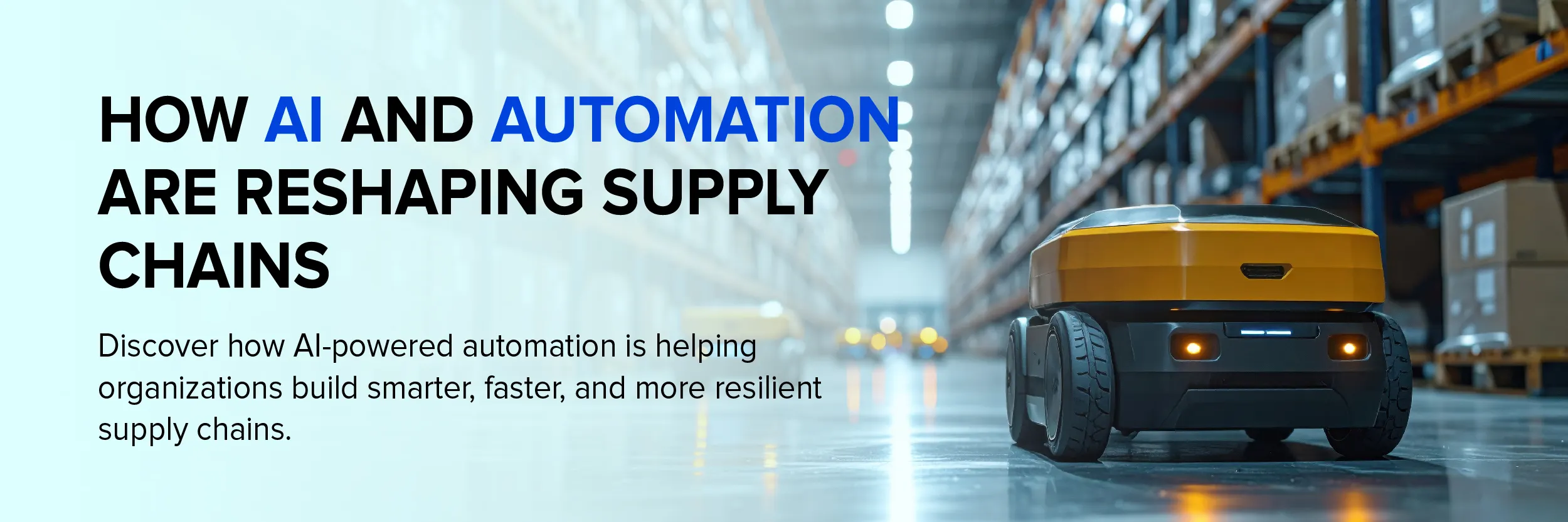
Smarter decisions, intelligent automation, and predictive insights are redefining how modern supply chains operate.
Supply chains have become more complex, interconnected, and unpredictable than ever before.
Fluctuating customer demand, geopolitical uncertainty, rising logistics costs, supplier disruptions, and increasing customer expectations are placing immense pressure on organizations to deliver faster, operate more efficiently, and remain resilient.
Traditional supply chain management approaches, built on historical data and manual planning, are no longer sufficient to keep pace with today's dynamic business environment.
To remain competitive, organizations are embracing Artificial Intelligence (AI) and intelligent automation to transform their supply chains from reactive operations into predictive, data-driven ecosystems.
AI is no longer simply improving supply chains—it is fundamentally reshaping how they are planned, managed, and optimized.
Why Traditional Supply Chains Need a New Approach
Many organizations still rely on disconnected systems, manual workflows, and reactive decision-making.
As supply chain networks expand across suppliers, manufacturers, logistics providers, warehouses, and customers, these limitations become increasingly difficult to manage.
Common challenges include:
- Demand uncertainty
- Inventory imbalances
- Limited supply chain visibility
- Manual planning processes
- Rising transportation costs
- Supplier performance variability
- Slow response to disruptions
Without real-time intelligence, organizations often react to problems after they have already affected operations.
The result is higher costs, reduced efficiency, delayed deliveries, and lower customer satisfaction.
The Rise of AI in Supply Chain Management
Artificial Intelligence enables organizations to analyze vast amounts of operational data in real time, identify patterns, predict future outcomes, and recommend optimal actions.
Instead of relying solely on historical reports, AI helps organizations anticipate changes before they occur.
Combined with supply chain automation, AI enables businesses to make faster, more informed decisions across planning, procurement, manufacturing, warehousing, logistics, and distribution.
This shift from reactive to predictive decision-making is becoming a key competitive advantage.
Intelligent Planning Through Predictive Analytics
One of the most valuable applications of AI in supply chain management is predictive analytics.
By analyzing historical performance, market trends, seasonal demand, supplier behavior, and external variables, AI can generate more accurate forecasts.
Predictive analytics helps organizations:
- Improve demand forecasting
- Anticipate supply shortages
- Reduce stockouts
- Minimize excess inventory
- Improve production planning
- Optimize procurement decisions
Better forecasting enables organizations to reduce uncertainty while improving responsiveness to changing market conditions.
From Prediction to Action: A Real-World Scenario
Consider a beverage manufacturer operating multiple production plants with hundreds of products. By integrating demand data into an AI-powered production planning solution, the organization gains a unified view of operations across its manufacturing network. AI continuously analyzes demand patterns, production capacity, inventory levels, and operational constraints to recommend optimized production schedules.
Instead of relying on manual planning cycles, planners can respond more quickly to changing customer demand, improve inventory utilization, reduce production waste, and align production with business priorities. This enables better collaboration across planning, manufacturing, and supply chain teams while helping the organization make faster, more informed decisions and adapt to changing market conditions.
Inventory Optimization with AI
Maintaining the right inventory levels remains one of the biggest challenges for supply chain leaders.
- Too much inventory increases carrying costs.
- Too little inventory creates stockouts and lost sales.
AI-powered inventory optimization continuously evaluates demand patterns, lead times, supplier reliability, and inventory movement to recommend optimal stock levels.
Organizations benefit through:
- Reduced inventory costs
- Improved inventory availability
- Better warehouse utilization
- Faster order fulfillment
- Improved working capital
Inventory decisions become more proactive rather than reactive.
Supply Chain Automation: From Manual Processes to Intelligent Execution
Automation is transforming repetitive supply chain activities into streamlined, intelligent workflows.
Modern organizations are using automation to improve:
- Purchase order processing
- Supplier collaboration
- Inventory replenishment
- Warehouse operations
- Shipment tracking
- Invoice matching
- Exception management
By reducing manual intervention, organizations improve speed, accuracy, and consistency across the supply chain.
Employees are able to focus on higher-value strategic activities instead of repetitive operational tasks.
Logistics Optimization Through AI
Transportation and logistics play a critical role in overall supply chain performance.
AI enables organizations to optimize logistics operations by analyzing multiple variables simultaneously, including:
- Delivery routes
- Carrier performance
- Transportation costs
- Warehouse capacity
- Customer demand
- Weather conditions
- Traffic patterns
This helps organizations reduce transportation costs while improving delivery performance and customer satisfaction.
Building Greater Supply Chain Resilience
Recent global disruptions have demonstrated the importance of resilient supply chains.
Organizations need the ability to identify risks early and respond quickly.
AI helps improve supply chain resilience by:
- Monitoring supplier performance
- Detecting potential disruptions
- Evaluating alternative sourcing options
- Predicting inventory shortages
- Supporting scenario planning
- Improving risk management
Rather than simply responding to disruptions, organizations can proactively prepare for them.
Business Outcomes That Matter
Organizations adopting AI and supply chain automation are realizing measurable business benefits, including:
- Faster Decision-Making: Access real-time insights that support quicker and more informed decisions.
- Improved Demand Forecasting: Increase forecast accuracy while reducing planning uncertainty.
- Lower Operational Costs: Optimize inventory, logistics, procurement, and resource utilization.
- Higher Productivity: Automate repetitive tasks and improve workforce efficiency.
- Better Customer Experience: Deliver products faster with improved order accuracy and reliability.
- Greater Supply Chain Resilience: Respond more effectively to disruptions and changing market conditions.
- Enhanced Operational Excellence: Build agile, data-driven supply chain operations capable of supporting long-term growth.
What Business Leaders Should Be Asking
Supply chain leaders should evaluate:
- Are we leveraging AI to improve demand forecasting?
- How much of our planning process remains manual?
- Can we identify supply chain risks before they impact operations?
- Are our inventory levels optimized using real-time data?
- Are automation initiatives delivering measurable business value?
- Do we have the visibility needed to make proactive decisions?
Organizations that can confidently answer these questions are better positioned to build resilient, intelligent supply chains.
FAQs (Frequently Asked Questions)
How is AI transforming supply chain management?
AI analyzes operational data to improve forecasting, optimize inventory, automate workflows, predict disruptions, and support faster decision-making across the supply chain.
What is predictive analytics in supply chain management?
Predictive analytics uses historical and real-time data to forecast demand, identify potential risks, and support more accurate planning decisions.
How does AI improve demand forecasting?
AI evaluates multiple variables—including historical demand, market trends, seasonality, and external factors—to produce more accurate demand forecasts.
What is inventory optimization?
Inventory optimization ensures organizations maintain the right inventory levels by balancing customer demand, lead times, and carrying costs.
How does automation improve supply chain performance?
Automation reduces manual work, accelerates workflows, improves accuracy, and enables employees to focus on strategic activities.
Why is supply chain resilience important?
Resilient supply chains can adapt more quickly to disruptions, reduce operational risk, and maintain business continuity during changing market conditions.
Looking Ahead
The future of supply chain management will be defined by intelligence, automation, and agility.
Organizations that combine AI, predictive analytics, and supply chain automation will be better equipped to anticipate change, optimize operations, and respond quickly to evolving customer and market demands.
As digital transformation accelerates, AI-powered supply chains will move beyond efficiency gains to become strategic enablers of business growth, resilience, and competitive advantage.
The organizations that invest in these capabilities today will be better positioned to lead tomorrow's supply chains.
How Merino Consulting Services Helps
Merino Consulting Services helps organizations modernize supply chain operations through AI-driven solutions, Cloud ERP, Supply Chain Management, Warehouse Management Solutions, Predictive Analytics, Process Intelligence, Automation, and digital transformation initiatives.
Our experts help businesses improve visibility, optimize planning, automate critical processes, and build smarter, more resilient supply chains that deliver measurable business value.