
The Hidden Costs of Disconnected Business Systems
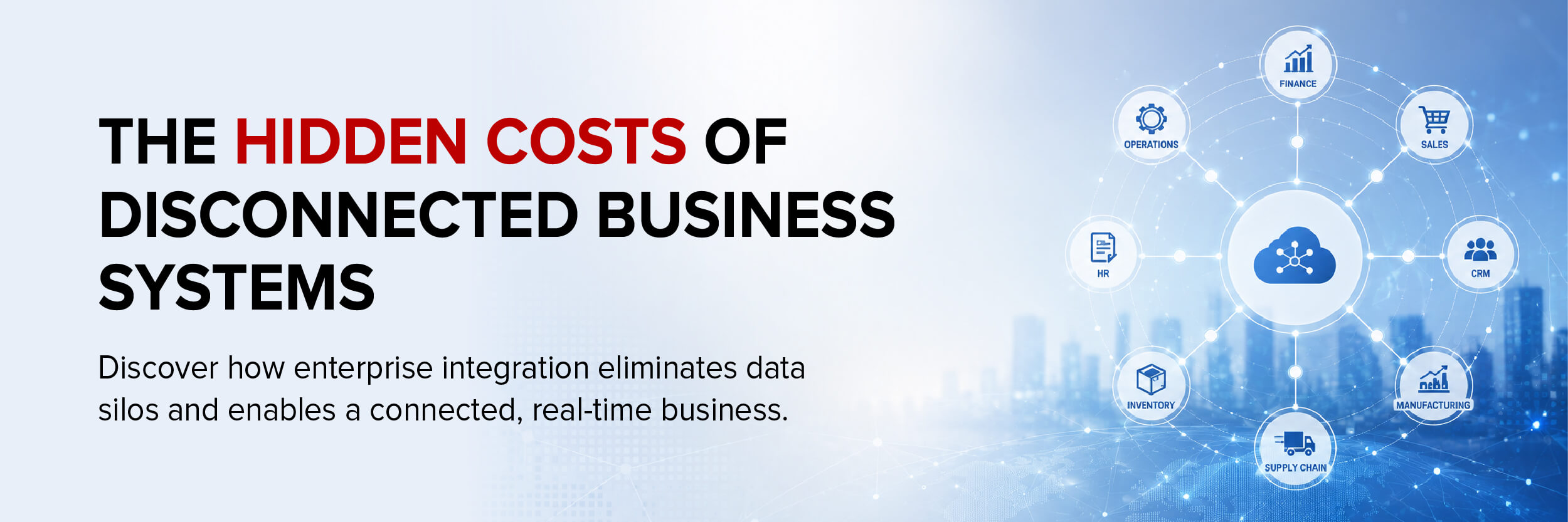
Why Enterprise Integration Has Become a Business Imperative
Organizations today generate more operational data than ever before.
ERP systems manage core business processes. CRM platforms capture customer interactions. MES solutions monitor production activities. WMS applications control warehouse operations. Additional systems often support procurement, finance, quality, maintenance, transportation, and business analytics.
While each application performs a critical role, many organizations continue to operate these systems independently.
The result is a fragmented technology landscape where valuable business information remains trapped in data silos, limiting visibility, slowing decision-making, and creating unnecessary operational complexity.
As manufacturers continue to accelerate digital transformation, enterprise integration is becoming essential—not simply to connect systems, but to create a connected enterprise where information flows seamlessly across every function.
The Hidden Cost of Data Silos
Disconnected business systems create challenges that extend far beyond IT.
When information cannot move seamlessly between applications, employees spend valuable time manually collecting, validating, and reconciling data before making decisions.
These inefficiencies often remain hidden because organizations gradually adapt their processes around system limitations rather than addressing the root cause.
Common signs of disconnected systems include:
- Duplicate data entry across multiple applications
- Inconsistent information between departments
- Manual spreadsheet consolidation
- Delayed operational reporting
- Limited visibility across business functions
- Slow response to customer and operational changes
- Difficulty tracking end-to-end business processes
Over time, these inefficiencies increase operational costs, reduce productivity, and limit an organization's ability to scale.
Why Enterprise Integration Matters
Enterprise integration connects business applications so information flows automatically across the organization.
Instead of operating as isolated systems, ERP, CRM, MES, WMS, and other enterprise applications work together to provide a unified view of business operations.
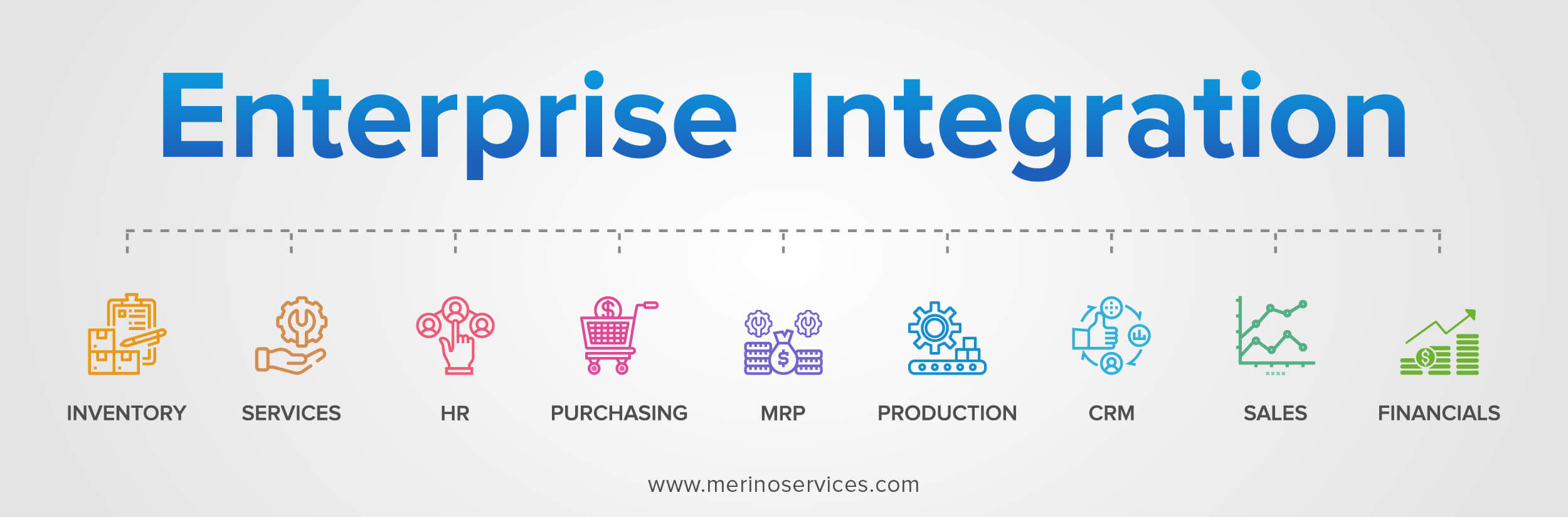
This enables organizations to eliminate duplicate processes, improve collaboration, automate workflows, and support faster, data-driven decision-making.
The objective is not simply connecting software—it is connecting the business.
Creating a Connected Enterprise
A connected enterprise enables every department to work from the same trusted information.
- Sales understands current inventory availability.
- Production teams receive accurate customer demand.
- Warehouse operations are aligned with manufacturing schedules.
- Procurement gains visibility into future material requirements.
- Leadership has access to real-time operational performance across the organization.
When systems communicate effectively, organizations spend less time searching for information and more time making strategic decisions.
From Data Silos to a Single Source of Truth
One of the greatest advantages of enterprise integration is creating a single source of truth.
Rather than maintaining multiple versions of the same information, integrated systems synchronize data automatically across the organization.
This improves:
- Data accuracy
- Reporting consistency
- Regulatory compliance
- Operational transparency
- Cross-functional collaboration
- Executive decision-making
With reliable, synchronized information, every department operates using the same business context.
A Real-World Manufacturing Scenario
Imagine a manufacturer receives a large customer order through its CRM platform.
Without enterprise integration, the sales team manually communicates demand to production. Production planners verify inventory separately within ERP. Warehouse teams receive shipping instructions later through emails or spreadsheets, while procurement independently reviews material requirements.
Each department works efficiently within its own system, but the overall process becomes slower, increasing the risk of communication gaps, delayed production, inventory discrepancies, and missed customer commitments.
In an integrated environment, customer orders automatically trigger updates across ERP, MES, and WMS systems. Production schedules adjust based on available capacity, inventory availability is updated in real time, procurement gains immediate visibility into material requirements, and warehouse operations prepare shipments without manual intervention.
The result is a faster, more coordinated process that improves operational efficiency while reducing delays and manual effort.
Improving Operational Visibility with Real-Time Data
Modern manufacturers require more than historical reports.
They need operational visibility as events happen.
Integrated systems provide real-time data across manufacturing, inventory, customer orders, procurement, and logistics.
This enables leaders to:
- Monitor production performance
- Track inventory movement
- Identify operational bottlenecks
- Respond quickly to supply chain disruptions
- Improve customer service
- Support proactive decision-making
Real-time visibility allows organizations to solve problems before they impact business performance.
Workflow Automation Across the Enterprise
Disconnected systems often require employees to manually transfer information between applications.
Enterprise integration enables workflow automation by allowing systems to exchange information automatically.
Examples include:
- Customer orders automatically creating production jobs
- Inventory updates synchronizing across ERP and WMS
- Production completion updating warehouse availability
- Procurement requests generated based on inventory thresholds
- Shipment status updating customer service teams automatically
Automation reduces manual work while improving speed, consistency, and accuracy.
The Business Value of System Interoperability
System interoperability ensures enterprise applications exchange information reliably regardless of the underlying technology.
Rather than replacing existing systems, organizations can maximize the value of their technology investments by enabling applications to communicate seamlessly.
This provides:
- Greater business agility
- Faster process execution
- Improved employee productivity
- Reduced operational risk
- Better customer responsiveness
- Scalable digital transformation
Business Outcomes That Matter
Organizations investing in enterprise integration achieve benefits that extend well beyond IT.
- Faster Decision-Making: Access accurate information across departments without waiting for manual reports.
- Greater Operational Efficiency: Eliminate duplicate work and streamline cross-functional processes.
- Improved Data Quality: Maintain consistent, synchronized information across business systems.
- Better Customer Experience: Respond faster to customer needs with accurate, real-time information.
- Enhanced Operational Visibility: Monitor enterprise performance across manufacturing, supply chain, finance, and customer operations.
- Stronger Business Intelligence: Enable analytics using trusted, integrated enterprise data.
- Scalable Digital Transformation: Create a connected technology foundation capable of supporting future innovation.
Questions Business Leaders Should Be Asking
As organizations continue modernizing operations, leaders should evaluate:
- Are our business systems sharing information automatically?
- How much time is spent reconciling data across departments?
- Do employees rely on spreadsheets to connect business processes?
- Can leadership access accurate operational data in real time?
- Are manual processes slowing customer response times?
- Does our technology landscape support future digital transformation initiatives?
The answers often reveal opportunities to improve efficiency, collaboration, and business performance.
FAQs (Frequently Asked Questions)
What are data silos?
Data silos occur when information is stored in separate business systems that cannot easily share or synchronize data, limiting visibility and collaboration.
What is enterprise integration?
Enterprise integration connects business applications—including ERP, CRM, MES, and WMS—to enable seamless data exchange and automated business processes.
Why is a single source of truth important?
A single source of truth ensures every department works with accurate, consistent, and synchronized business information, improving decision-making and reducing errors.
How does enterprise integration improve manufacturing operations?
Integrated systems provide real-time operational visibility, automate workflows, reduce manual effort, improve planning, and strengthen collaboration across manufacturing, warehouse, supply chain, and customer-facing teams.
Can organizations integrate existing systems instead of replacing them?
Yes. Modern integration platforms enable organizations to connect existing enterprise applications, protecting technology investments while improving interoperability and operational performance.
Looking Ahead
The future of manufacturing will not be defined by the number of enterprise applications an organization owns—it will be defined by how effectively those systems work together.
Organizations that eliminate data silos, establish a connected enterprise, and leverage real-time data will be better positioned to improve operational efficiency, accelerate decision-making, and respond quickly to changing business demands.
Enterprise integration is no longer simply an IT initiative. It has become a strategic capability that enables sustainable growth, operational excellence, and long-term digital transformation.
How Merino Consulting Services Helps
Merino Consulting Services helps organizations build connected enterprises by integrating ERP, CRM, MES, WMS, supply chain, manufacturing, and business applications into a unified digital ecosystem.
Our experts enable enterprise integration, workflow automation, real-time operational visibility, and data synchronization, helping organizations eliminate silos, improve decision-making, and accelerate digital transformation with measurable business outcomes.