
Why Supply Chain Agility Matters More Than Ever
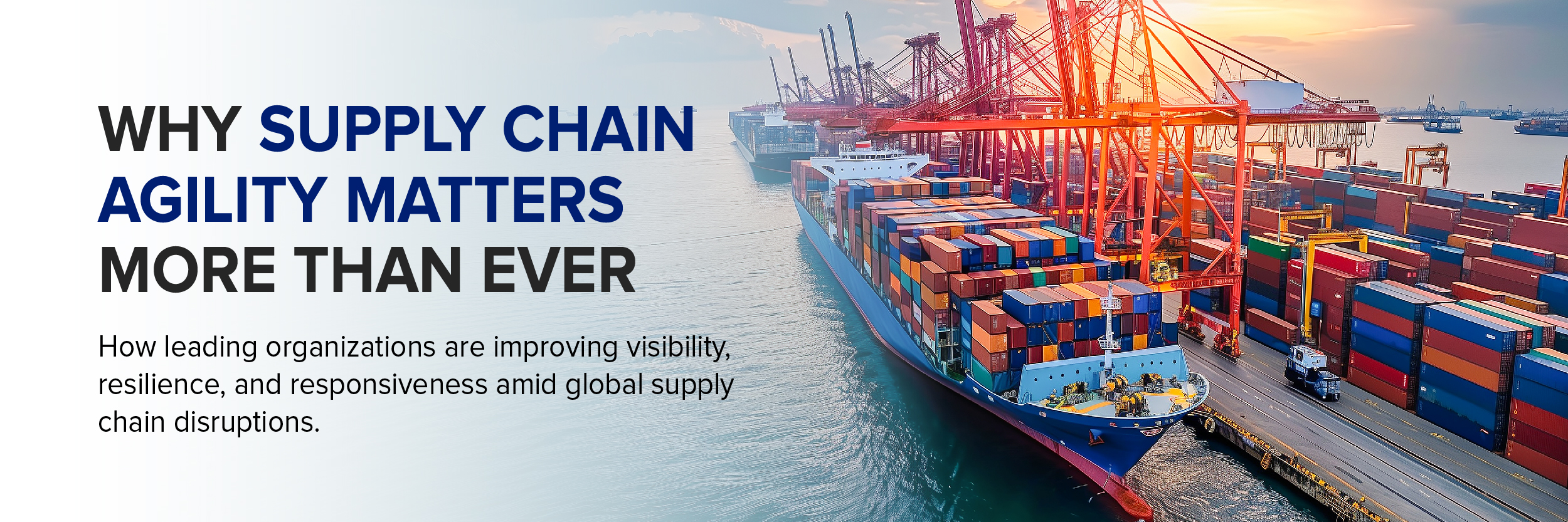
Recent disruptions are exposing weaknesses in traditional supply chains. Discover how visibility, flexibility, and intelligent technologies help organizations stay resilient and responsive.
For years, businesses have focused on optimizing supply chains for efficiency and cost reduction. Today, however, a new priority has emerged: agility.
Shifting customer demand, transportation delays, supplier constraints, rising logistics costs, and global uncertainty can disrupt operations with little warning. Organizations that rely on rigid processes and disconnected systems often struggle to respond quickly, leading to inventory shortages, delayed deliveries, and increased operational costs.
The ability to adapt rapidly to changing conditions has become a key competitive advantage.
The Growing Need for Supply Chain Agility
Recent disruptions across global trade routes and logistics networks have highlighted the importance of resilience and responsiveness. Even a temporary disruption in a critical shipping corridor can create ripple effects across procurement, manufacturing, warehousing, and distribution operations.
For manufacturers, process industries, and distributors, these challenges can result in:
- Inventory shortages or excess stock
- Production delays
- Increased transportation costs
- Longer lead times
- Reduced customer satisfaction
- Lower profitability
Organizations that can quickly identify risks, adjust plans, and maintain continuity are better positioned to protect both revenue and customer relationships.
The Three Pillars of an Agile Supply Chain
1. Visibility
You cannot respond to disruptions you cannot see.
Real-time visibility across inventory, suppliers, warehouses, production facilities, and logistics operations enables faster and more informed decision-making.
Organizations with end-to-end visibility can identify potential issues early and take corrective action before they impact customers.
2. Flexibility
Agile organizations can quickly adapt to changing conditions.
Whether it's sourcing from alternative suppliers, adjusting production schedules, reallocating inventory, or modifying fulfillment strategies, flexibility helps businesses maintain continuity while minimizing disruption.
3. Intelligence
Modern supply chains generate enormous amounts of data. The challenge is turning that data into actionable insights.
Artificial Intelligence, analytics, and Process Intelligence help organizations forecast demand, identify risks, optimize inventory, and improve planning accuracy.
The result is faster, smarter, and more proactive decision-making.
How Technology Enables Supply Chain Agility
Technology plays a critical role in creating connected and responsive supply chains.
Cloud ERP
Modern ERP platforms such as Infor CloudSuite and SAP S/4HANA Cloud provide a unified view of operations across procurement, inventory, manufacturing, finance, and distribution.
By centralizing data and processes, Cloud ERP helps organizations respond faster to changing business conditions.
Warehouse Management Systems (WMS)
Warehouse Management Systems improve inventory accuracy, warehouse efficiency, order fulfillment speed, and operational visibility.
With real-time inventory information, businesses can reduce stock discrepancies and improve customer service levels.
Artificial Intelligence and Analytics help
- Predict demand fluctuations
- Identify potential supply chain risks
- Optimize inventory levels
- Improve forecasting accuracy
- Support faster decision-making
By moving from reactive management to predictive planning, businesses can better navigate uncertainty.
The Business Impact of Supply Chain Agility
- Faster response to market changes
- Improved inventory management
- Better customer service and fulfillment performance
- Reduced operational risk
- Greater supply chain resilience
- Increased efficiency and profitability
In today's environment, agility is no longer just a supply chain objective—it is a business necessity.
Looking Ahead
The future belongs to organizations that can anticipate change and respond with confidence.
By combining Cloud ERP, Supply Chain Management, Warehouse Management Systems, Artificial Intelligence, and Process Intelligence, businesses can build supply chains that are not only efficient but also resilient, connected, and ready for whatever comes next.
How Merino Consulting Services Helps
Merino Consulting Services helps organizations modernize and optimize supply chain operations through ERP, Supply Chain Management, Warehouse Management Solutions, Artificial Intelligence, Process Intelligence, Business Intelligence, and cloud transformation initiatives.
Whether you're looking to improve visibility, optimize inventory, strengthen warehouse operations, or build a more resilient supply chain, our experts can help you create a connected and agile enterprise prepared for future challenges.